
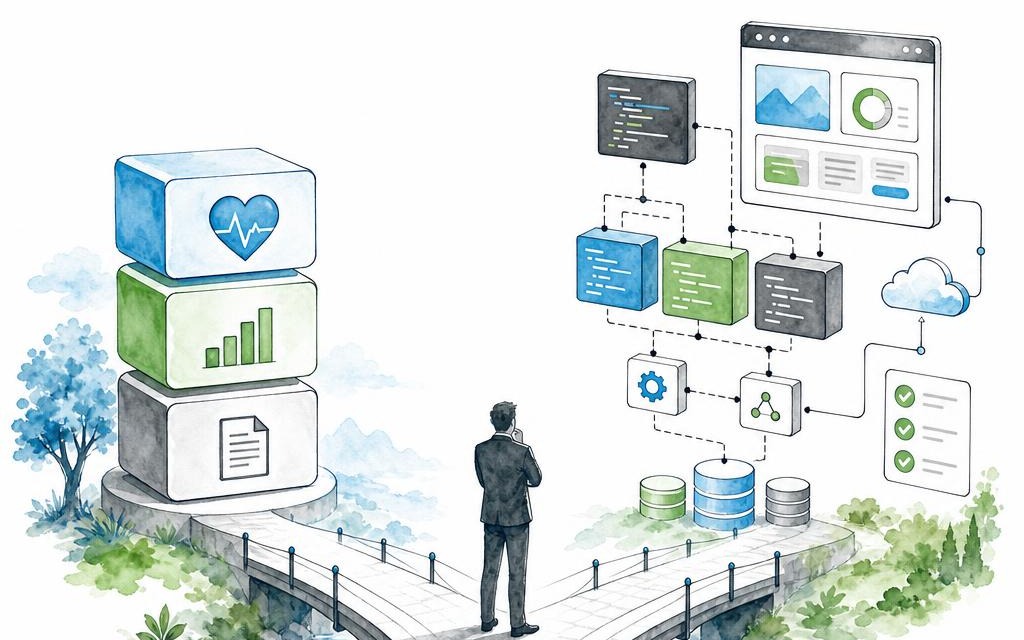
A vertical AI agent is a preconfigured application for a defined domain process. Code-first tools such as Codex, Claude Code, Cursor and Replit Agent instead help create and modify software. These are different procurement choices, not a general ranking of model quality.
Reviewed 8 September 2026. Product capabilities change quickly. Before purchasing, verify the linked vendor documentation, the specific contract, data flows and a pilot using your own requirements.
The short decision
- Vertical agent: appropriate where the process is standardized, required controls and integrations already exist, and a ready operating model matters more than custom product design.
- Code-first: appropriate where business logic, experience, integrations or the operating model must remain under your control.
- Hybrid: often practical when a custom application embeds a specialist domain API or vertical service.
| Criterion | Vertical agent | Code-first |
|---|---|---|
| Starting point | ready domain process | brief, repository or product idea |
| Customization | within product boundaries | through architecture and code |
| Integrations | available connectors and APIs | documented interfaces and your engineering effort |
| Governance | partly built in | must be designed, tested and operated |
| Cost | vendor-dependent license, transaction or consumption | plan, Agent use, development, assurance, hosting and operations |
These categories are not a price forecast. List prices, enterprise discounts, consumption, support and operations vary by product and contract.
The four code-first products
OpenAI describes Codex as a coding agent for software development. Anthropic describes Claude Code as a coding agent working in development workflows and codebases. Both still require architecture, identity, testing, deployment and operational controls around a production application.
Cursor is an AI code editor and coding agent. According to Cursor's Privacy Mode documentation, data is not used for training by Cursor or model providers when Privacy Mode is enabled, and it is enabled by default for teams. Subprocessors, retention and contract terms still require review.
Replit Agent can create web and mobile apps, data visualizations and other artifacts and set up infrastructure. The Design Canvas mentioned there is for visual designs and prototypes. It is not itself an external customer portal. A B2C or partner portal is a published application requiring suitable authentication, privacy, operations and support.
Procurement questions
Determine which data and identities are required; what the plan includes versus meters separately; where prompts, code, logs, backups and production data are processed; which training and retention terms apply; and whether code, data and configuration can be exported. Compare total cost using your own load profile rather than an unsupported ROI claim.
Conclusion
Buy the standard where its boundaries fit. Build where the process or user experience is strategic. Prove the choice with an end-to-end pilot.
Sources retrieved 8 September 2026: OpenAI Codex · Anthropic Claude Code · Cursor Privacy Mode · Replit Agent and Design Canvas