
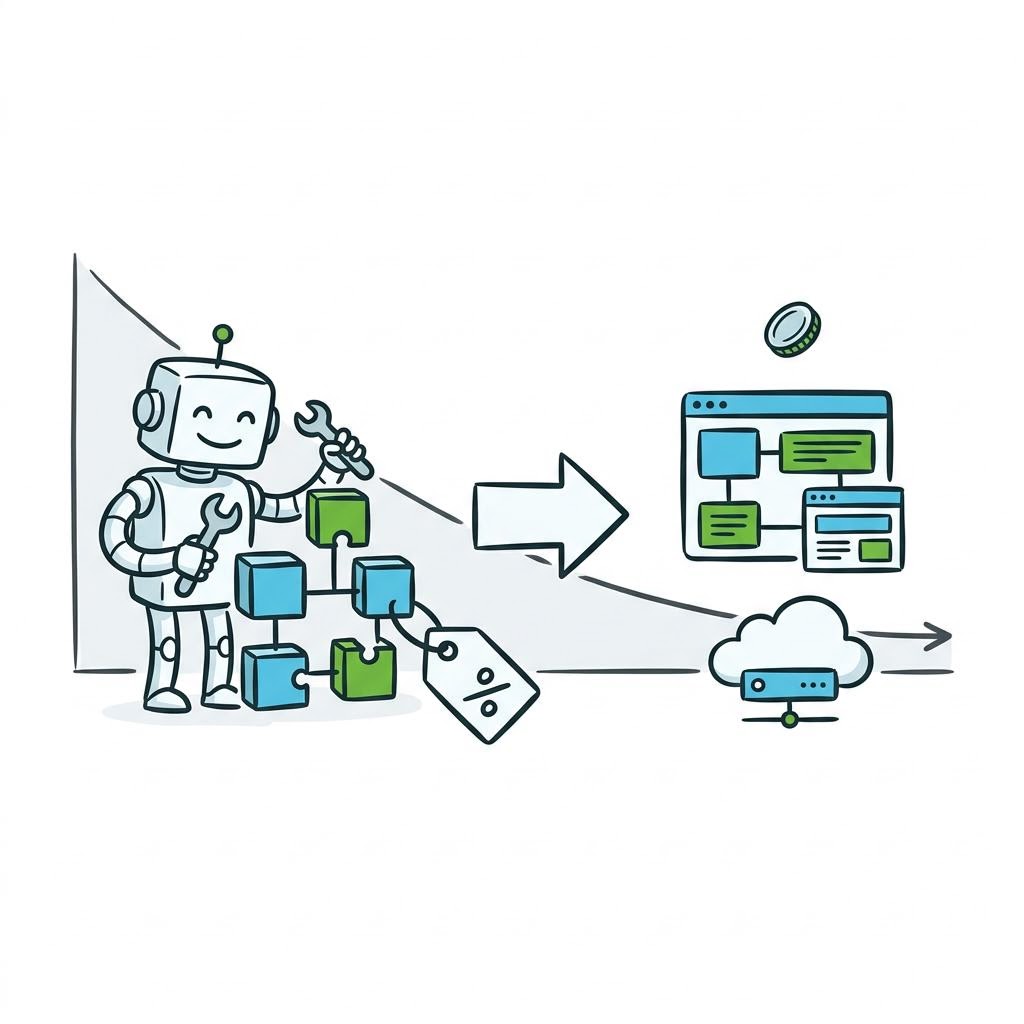
Three parts of this series dissected three pricing models: credits (Copilot Studio), seat licenses (Microsoft 365 Copilot) and consumption meters (Azure AI Foundry). All three share one property: the costs keep running as long as the solution runs. Replit Agents invert that logic: the biggest cost block occurs once — at build time. After that, the solution runs for a fraction of what every other model charges.

This final part works out, with list prices verified in August 2026, what a solution built with the Replit Agent and hosted on Replit costs at 100, 500 and 1,000+ users — and then draws the overall comparison across all four platforms.
Note: All prices are USD list prices (as of August 2026) from the official Replit pricing pages and documentation. CHF amounts are rounded conversions (1 USD ≈ 0.80 CHF).
The component inventory: what a Replit solution needs
| Component | Billing | List price (August 2026) |
|---|---|---|
| Replit subscription (Core) | per month | $20 — includes $20 of usage credits |
| Replit subscription (Pro) | per month | $100 — includes $100 of usage credits |
| Agent build cost | per checkpoint (effort-based) | one-time, scales with complexity |
| Hosting: Autoscale | base fee + usage | $2/month + $0.60/1M compute units + $0.40/1M requests |
| Hosting: Reserved VM | per month | $15 (0.5 vCPU/2 GB) · $35 (1/4) · $50 (2/8) · $130 (4/16) |
| PostgreSQL database | compute time + storage | usage-based, development free |
| App Storage (object storage) | per GiB / month | $0.015 + $0.05/GiB transfer |
| In-app AI (e.g. GPT-5 via API) | per token | $1.25 / 1M input, $10 / 1M output |
Two things stand out. First: there is no per-user cost. Whether 100 or 1,000 people use the app changes nothing about the subscription — only hosting and any AI calls scale along. Second: Agent build costs are effort-based — simple tweaks cost cents, full features are bundled into checkpoints. From our project practice: an agentic MVP typically lands at $200–800 of Agent usage, a full-grown internal solution at $500–1,500 — plus the implementation partner's design and quality-assurance effort.
AIOnomics: when the formula collapses into a one-time payment
The series formula — Monthly cost = users × queries/user × units/query × price/unit — applies at Replit only to the smallest cost block: the optional in-app AI calls. Hosting is a fixed base, the subscription a constant, and the biggest item — the build — has vanished from the monthly bill entirely. It becomes an amortization calculation: one-time cost divided by months of use.
The animation shows how the one-time build cost amortizes against the perpetual license cost of the other models:
A worked example: an internal knowledge app costs CHF 8,000 one-off (build incl. Agent usage and partner effort) and CHF 60/month to run. Microsoft 365 Copilot for the same 100 users costs CHF 2,400/month. The Replit solution is cheaper after four months — and CHF 2,300 cheaper every month from then on.
Baseline 1: 100 users
Assumptions: internal knowledge app with an AI feature, 30 queries per user per month (3,000 queries at ~$0.01 — lean prompt, 2,000 input / 500 output tokens, GPT-5), small reserved VM, Core subscription.
| Item | Calculation | Cost / month |
|---|---|---|
| Replit Core | fixed (incl. $20 credits) | $20 |
| Reserved VM (0.5 vCPU/2 GB) | fixed | $15 |
| Database + storage | usage-based, small | ~$5 |
| In-app AI | 3,000 × $0.01 | $30 |
| Credit offset | −$20 | −$20 |
| Total running | ~$50 ≈ CHF 40 |
Plus one-off: build ~CHF 5,000–12,000 (depending on scope). Spread over 24 months that is CHF 210–500/month — even including amortization, the solution stays below a quarter of the M365 Copilot license cost for the same user count.
Baseline 2: 500 users
15,000 AI queries/month, dedicated VM (1 vCPU/4 GB), growing database.
| Item | Calculation | Cost / month |
|---|---|---|
| Replit Core | fixed | $20 |
| Reserved VM (1 vCPU/4 GB) | fixed | $35 |
| Database + storage | usage-based | ~$10 |
| In-app AI | 15,000 × $0.01 | $150 |
| Credit offset | −$20 | −$20 |
| Total running | ~$195 ≈ CHF 155 |
Baseline 3: 1,000+ users
30,000 AI queries/month, larger VM (2 vCPU/8 GB), more data volume.
| Item | Calculation | Cost / month |
|---|---|---|
| Replit Core | fixed | $20 |
| Reserved VM (2 vCPU/8 GB) | fixed | $50 |
| Database + storage | usage-based | ~$20 |
| In-app AI | 30,000 × $0.01 | $300 |
| Credit offset | −$20 | −$20 |
| Total running | ~$370 ≈ CHF 295 |
CHF 295 per month for 1,000 users is around 30 centimes per head — two orders of magnitude below the seat license. And the lion's share is not Replit but the AI calls; a solution without an LLM feature (a classic business app) runs for under CHF 80/month regardless of user count.

The grand platform comparison: all four models
The series finale in one table — running costs in CHF per user per month, excluding one-time build costs:
| Users | Copilot Studio (credits) | M365 Copilot (license) | Azure AI Foundry (meters) | Replit (build & host) |
|---|---|---|---|---|
| 100 | ~CHF 3–7 | CHF 17–24 | ~CHF 1.20 | ~CHF 0.40 |
| 500 | ~CHF 3–6 | CHF 24 | ~CHF 1.10 | ~CHF 0.30 |
| 1,000 | ~CHF 3–6 | CHF 24 | ~CHF 1.20 | ~CHF 0.30 |
The animation shows the comparison across all three user tiers:
And the honest counter-calculation of one-time and staff efforts:
| Copilot Studio | M365 Copilot | Azure AI Foundry | Replit | |
|---|---|---|---|---|
| Build cost (one-off) | CHF 4,000–12,000 (low-code) | rollout CHF 6,000–18,000 | CHF 25,000–75,000 | CHF 5,000–15,000 |
| Operating effort | ~0.5 person-days/month | 0.5–1 person-days/month (adoption) | 1–2 person-days/month | < 0.5 person-days/month |
| Customizability | medium | none | maximum | high |
| Data sources | M365-native | M365-native | anything | anything |
The decision rule
- M365 Copilot when the value is created inside the Office apps themselves and heavy users saturate the license.
- Copilot Studio when the knowledge lives in Microsoft 365 and a standard agent without a development project is enough.
- Azure AI Foundry when hard requirements (custom models, compliance, latency) justify a full stack and a team carries the operations.
- Replit when a tailor-made solution is needed, the user count is large or the budget small — and the solution should run with minimal maintenance after the build.
Five cost levers for Replit solutions
1. Cut the scope tight. The Agent builds effort-based — every feature nobody needs costs checkpoints. A precise briefing saves real money at build time.
2. Autoscale for sporadic usage. Internal tools with few hits run cheaper on Autoscale ($2 base fee plus usage) than on a permanently reserved VM.
3. Reserved VM only at constant load. Switching to a dedicated VM pays off once the app must respond around the clock — before that, you pay reservation for idle time.
4. Model choice for in-app AI. The biggest running item is the LLM calls. A mini model for routine queries cuts the variable bill by 40–70% — the same lever as at Foundry.
5. Use the credits. Core and Pro subscriptions include usage credits equal to the subscription price — small solutions effectively run at the subscription price alone.
Conclusion: the series in one sentence
Four platforms, four pricing logics: credits get consumed, licenses keep running, meters tick per token — and Replit shifts the cost to where it occurs once: the build. If you know your usage patterns, you don't pick the "best" platform — you pick the one with the matching cost curve. That is exactly the calculation we run with our clients before the first line gets built.
How CNEXT can help
- Platform assessment: we run your scenarios across all four models — with current list prices and your real usage figures.
- Agent MVP in days: as a Replit partner, we build your solution with the Replit Agent — from prototype to production.
- Operating model: hosting, monitoring and further development — low-maintenance and with clear cost transparency.
Before you license, we do the math: Get in touch →
Sources (all retrieved August 2026): Replit pricing · Replit deployment pricing · Replit App Storage pricing · Replit Agent billing · Azure OpenAI pricing
Further reading:
